



Special thanks as always to Happy Hen Toys for sending this one out. If you want this figure or anything else from Schleich and more, prehistoric and extant, they have you covered. Now on to the review.

One of the most famous prehistoric animals out there is Dimetrodon, and as a result it is commonly represented on the toy market. I mean just take a look at the number of reviews on the blog here for it. A decade after Schleich’s first orange iteration released (which would receive a repaint in green colors in 2019), they are back with a brand new sculpt. Right off the bat I think this new iteration is a big improvement over the prior releases (not that I disliked them), but still, it isn’t without some faults unfortunately. Hopefully Dimetrodon itself needs no introduction here, but just in case, no it was not a reptile, or a dinosaur (having lived before they showed up in the Late Triassic), but a synapsid from the Early Permian period (and from the family Sphenacodontidae). There are quite a number of species of it too, with most being from the Red Beds of Texas and Oklahoma. Depending on the species, it may have lived alongside animals like Diplocaulus, Edaphosaurus, Eryops, and many others.

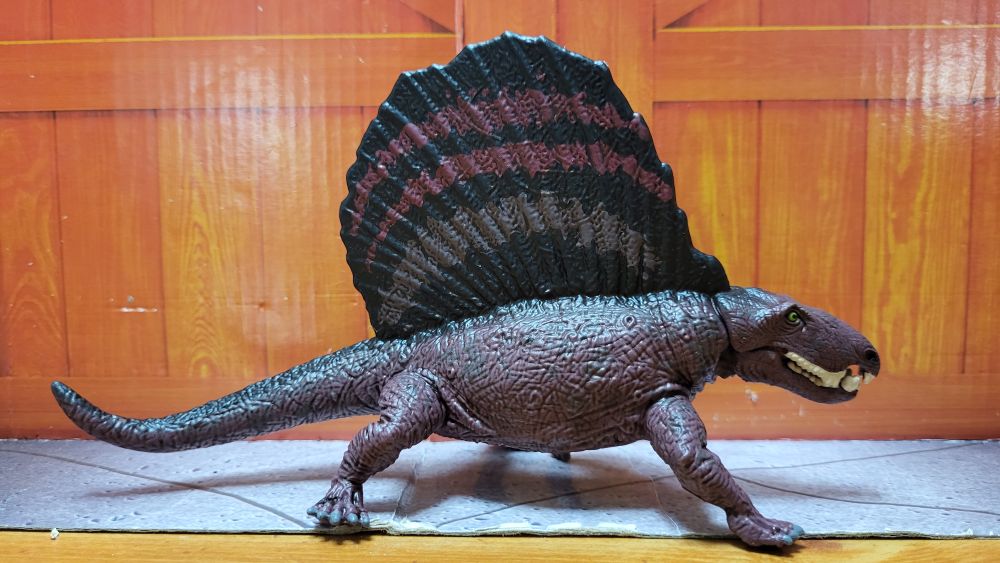

This newest iteration is in an upright walking pose, has better proportions (such as smaller feet, and a longer tail), and a more subdued coloration. Compared to the 2016 rendition covered in wart like bumps, the body’s detail mostly consists of simple cross-hatching, with some bumps here and there. Some of the bumps have strange pits on them, mostly on the right side of the figure, and the underside. Unfortunately compared to the rather promising promo images, the sculpt detail on the body is strangely blurry, reminding me of a lower resolution texture (or poor UV mapping) in a video game, poorly contrasting with the sharper detail of the head sculpt (minus the teeth). The teeth are also badly blobby, and crudely painted white, and while it is typical of Schleich figures these days, it still detracts from the overall aesthetics of the sculpt (at least when looking at it close up), and of course the lack of “lips” means they can’t be hidden. There’s also a number 2 printed on the right side of the head, strangely. Of course also worth mentioning is that the figure is of a decent size as well, measuring about 17.78 cm (7 inches) long, and 10.16 cm (4 inches) tall at the highest point of the sail. It also has an articulated jaw that can open up quite wide.
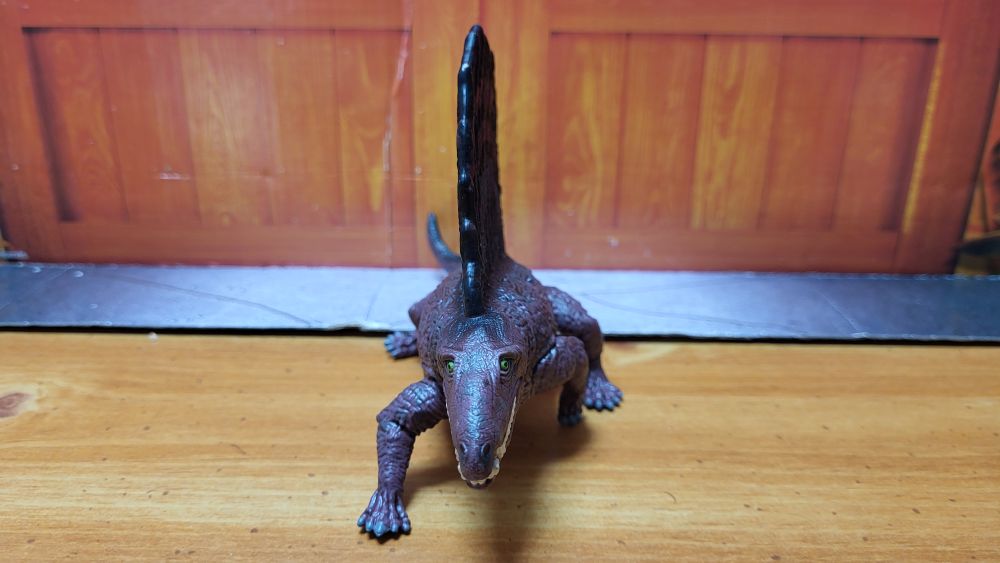

Despite the molding issues, I do still find this figure rather appealing, and that’s definitely due in thanks from the coloration, and the posture. The eyes are a striking green color, which is not something I’ve seen too often with reconstructions of this genus, which contrasts really nicely with the more muted body coloration. The body is mostly a purple color, with some light pink on the underside, and the sail is mostly black, but there’s an interesting mix of red and pink stripes on it. The black color of the sail also continues down the length of the tail. The pose is also one of the more interesting ones I’ve seen in a Dimetrodon figure, capturing it in mid stride, with the left forelimb pushing back, and the tail swishing to the side. This guy is on the move, perhaps in search of some Diplocaulus (which there’s direct, and rather brutal fossil evidence for), or any other prey item.


Known from a bunch of species, it’s hard to pinpoint if the sculptor referenced any in particular, and as such if this was ever intended to represent any in particular. The shape of the teeth is nearly characteristic of Dimetrodon grandis (although the first pair of teeth on the upper jaw should be longer, and there are also too few), but the long proportions of the head seems closer to that of D. angelensis, which is also the largest species. As far as sail shape is concerned, the overall shape seems closest to D. grandis, or perhaps D. limbatus, but the number of spines is too few. It does correctly have five digits on the forelimbs and hind limbs.
Just last year a paper on sphenacodontid skin impressions was published (Marchetti et al), and while the figure was likely sculpted, or in production prior to this finding, it of course deviates quite a bit from it with the simple cross-hatching used. I don’t hold it against the figure, but thought it was worth pointing out just in case, as it was a rather interesting, and important find.


Ultimately I can only recommend this figure to fellow collectors if you enjoy the color scheme or the pose, or are a fan of Schleich products to begin with. It’s not particularly scientifically rigorous like some other figures of Dimetrodon out there, and the decrease in detail from the prototype (or what was shown in the promo images) due to whatever went on with the molding process certainly takes it down a notch. That said at the end of the day it is also a toy, intended for children, and it no doubt would serve its role well enough for any kids wanting a Dimetrodon to play around with (if not several considering the plethora of options out there for this animal).

Disclaimer: links to Ebay and Amazon on the DinoToyBlog are affiliate links, so we make a small commission if you use them. Thanks for supporting us!
Can’t get over that face. Those teeth look just so terrible.
The prominent number 2 does not help either, especially given that the figure is brown.