



Review and photographs by Funk, edited by Suspsy
UKRD released a series of dinosaur toys in the early 1990s’, and I remember my kindergarten class had dozens of them. They came in at least three size classes, with the medium ones being most prevalent. Many of them seem to have been modelled after John Sibbick’s artwork in David Norman’s classic 1985 Illustrated Encyclopaedia of Dinosaurs, though with different colour schemes (clear examples of this are the Allosaurus, Parasaurolophus, and Iguanodon). This is also true for the subject of this review, though with some caveats regarding its identity that will be discussed below (beware, it will be as complicated as modern ankylosaur taxonomy is).
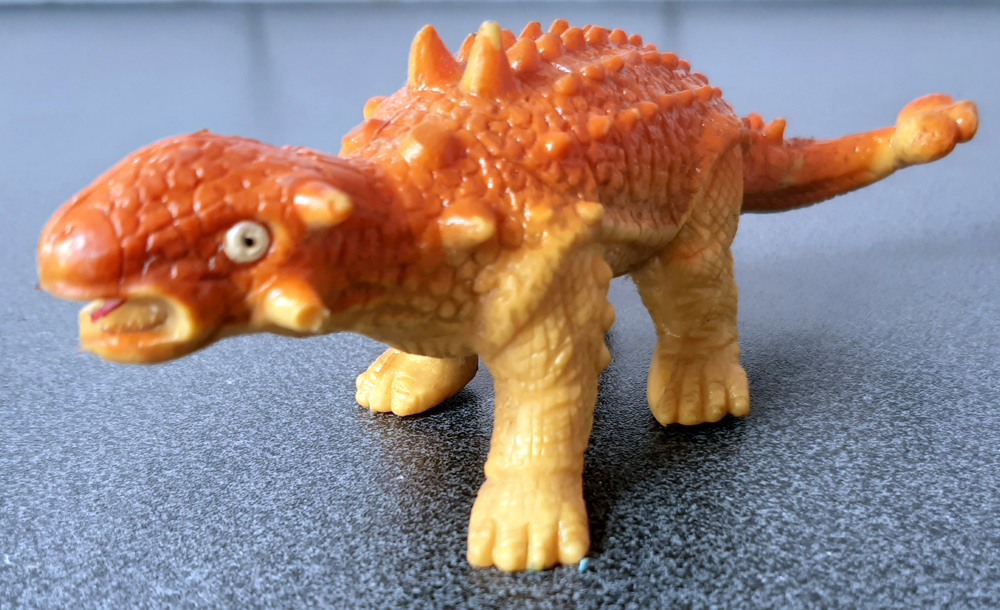
What we have here is a figure labelled as Ankylosaurus on its belly, a famous genus known from surprisingly incomplete fossil material, but this is clearly not what the toy depicts. Instead, it almost perfectly matches Sibbick’s illustration of the related ankylosaur Euoplocephalus in shape and pose, while differing by its entirely orange colouration. Even disregarding Sibbick’s art, we can identify it as Euoplocephalus based on the two spikey osteoderms above the shoulders, the very wide tail knob, and the fact that its nostrils face forwards rather than to the sides, which is unique for Ankylosaurus. Why UKRD did not label it as Euoplocephalus may be due to it also being an ankylosaur (a member of the family Ankylosauridae and the suborder Ankylosauria), and lay persons have often confused common terms for dinosaur families with the genera these are named after (a recent case is the “Nodosaurus” in the game Jurassic World Alive that is clearly based on Borealopelta, which was referred widely as just a “nodosaur” in the media before it was formally named).
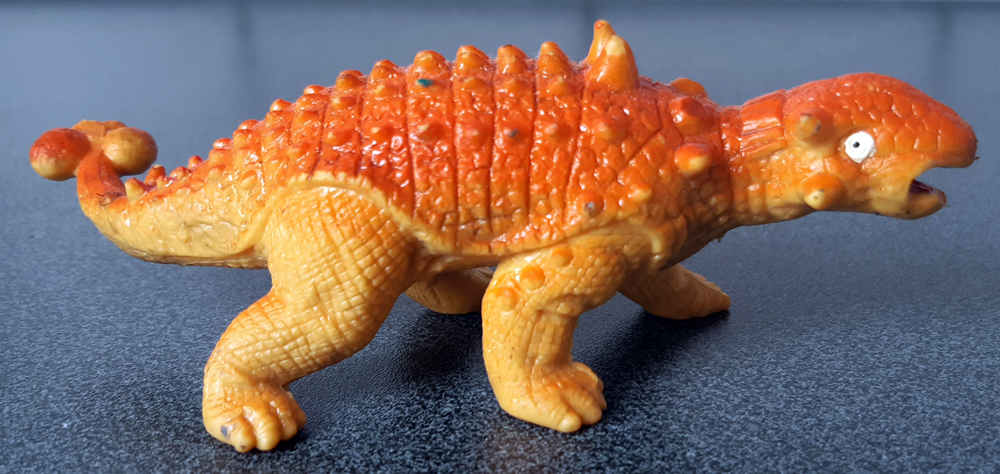
However, ankylosaur taxonomy has been in a state of flux in recent years, so I would argue we cannot even call it Euoplocephalus anymore. The specimen with the shoulder spikes that is the basis for this feature being depicted on Euoplocephalus is the one at the Natural History Museum in London (NHMUK R5161), which is itself what the genus Scolosaurus is based on. This specimen has some of the best preserved ankylosaur armour known for many years, as the osteoderms were in their life position on the skin, and not scattered all around. Now, Scolosaurus was long considered a junior synonym of Euoplocephalus (since 1971) until it was revived in 2013. So can we conclude that the figure is a Scolosaurus then? Not so fast . . .
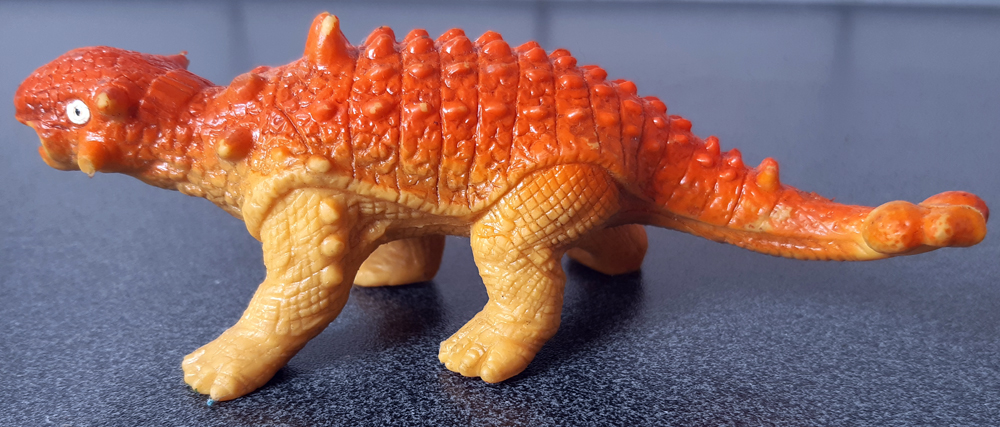
It just so happens that the tail on Sibbick’s image, and thus on the figure, is also based on a very distinct specimen which was also assigned to Euoplocephalus: a broad tail club consisting of two large, distinctly shaped osteoderms with two smaller ones poking out at the tip. As part of the same taxonomic flux mentioned above, this tail club (specimen AMNH 5245) has since been reassigned to Anodontosaurus, another genus which was until recently considered a synonym of Euoplocephalus. What the skull is based on is uncertain; the head in Sibbick’s image and the toy is similar to a tall, domed skull which is depicted diagrammatically in the book, as well as in some skeletal reconstructions of Euoplocephalus by Gregory S. Paul which combine it with the body of Scolosaurus. This skull (AMNH 5405) has been assigned to either genus by different authors in recent years. So what we have here is, like most, if not all, other Euoplocephalus depictions in existence, a chimaera of a Scolosaurus body, an Anodontosaurus tail club, and, depending on who you ask, the skull of Euoplocephalus itself. Add to this that the figure is labelled as Ankylosaurus, and we are left with a quadrupled chimaera.
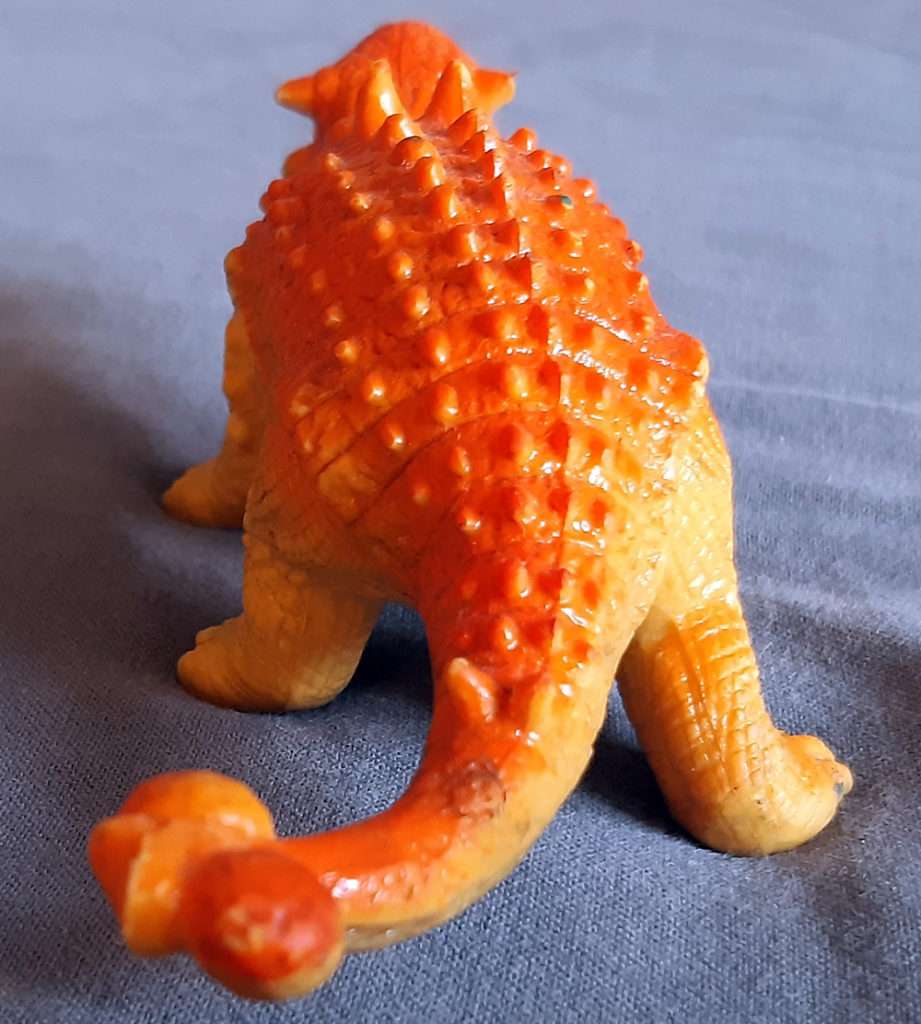
Okay, with all this out of the way, let’s go on with describing the figure. It is about 14 cm long, and disregarding the taxonomic issues above, it is a fairly decent rendition of what Euoplocephalus was thought to have looked like in the 80s’ and 90s.’ The armour on the body is a good match to the London Scolosaurus specimen, as is the tail club to the AMNH specimen, though the large osteoderms seem a bit too round. Unlike many other of his dinosaurs in the book, Sibbick’s ankylosaurs do not drag their tails along the ground, which also gives this figure a more modern look than the other UKRD dinosaurs, most of which drag their tails (even the Velociraptor). Similar to Sibbick’s depiction, the figure is in mid-stride, with a wide open mouth, and the tail curving towards its left.
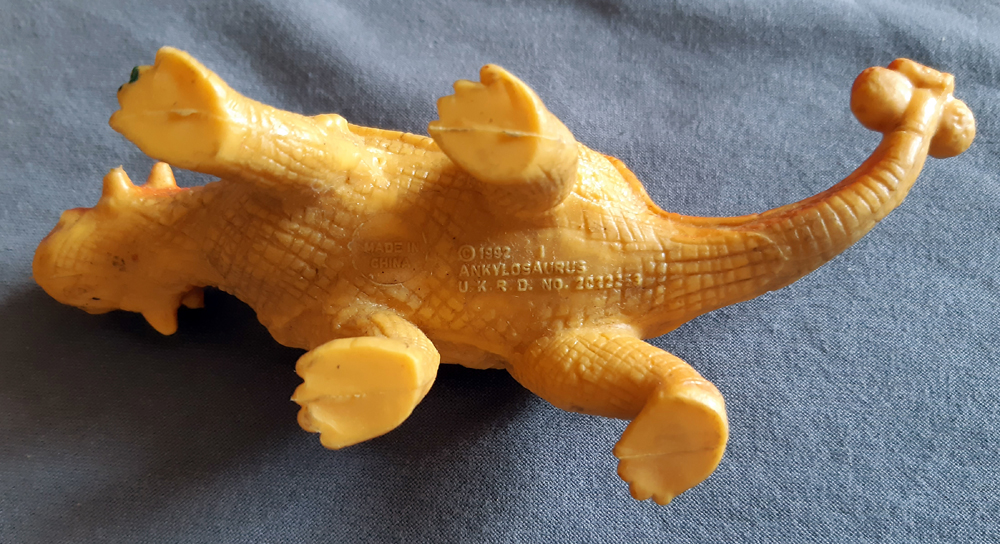
The colour scheme is a rather surprising orange (compared to the dull colours ankylosaurs are often depicted with), which seems to be the colour of the rubber it is made of. The armour on the back is painted in a slightly darker orange, the tongue is red, and the eyes are white with black pupils. But the paint here is applied rather sloppily; as with many such figures, this one has much smaller eyes than what the paint splotches would indicate, which always looks awful.
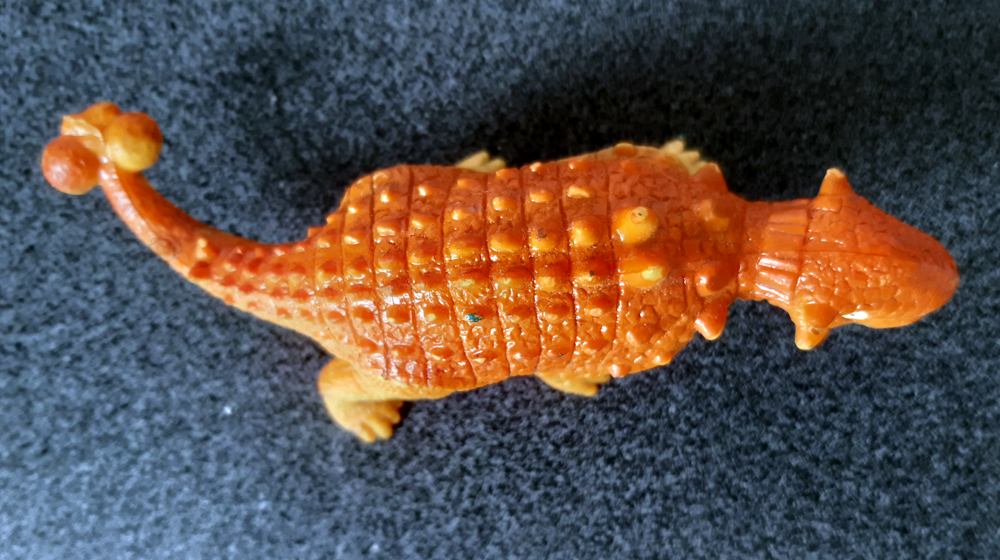
While previous UKRD reviews have dismissed the figures as being ugly, I think this and a few of the other ones have some charm in seemingly being based on some nice 1980s’ paleoart. This one in particular is pretty dynamic and detailed for an ankylosaur toy of that era (this one has 1992 stamped on its belly), and the UKRD toys undoubtedly have nostalgic value for a lot of people who were kids at the time. So many of these were produced that I doubt they’ll be hard to find or particularly expensive for anyone looking for them.
Addendum
Long after I reviewed this figure, I found my skeletal version of it; such versions appear to have been made of all the mid-size “UKRD” figures, in both standard white and glow-in-the-dark variants. Like the other skeletons, it is similar in proportions and pose to the live version. As these skeletons appear to have been sculpted with little regard for the actual fossil material, it’s almost pointless to examine their accuracy, but there are some other interesting aspects of this particular case.

The skeletal version is obviously sculpted after the live version, the main difference being that the tail is straighter. The skull is recognisable as that of an ankylosaurid with the four horns, but as with the other skeletal figures, there’s no separation between the skull and mandible, which would have made eating rather difficult… There is an attempt at depicting the osteoderms, and while these seem successful enough for the tail-club, the ones on the rest of the body are rather puzzling. Or rather, the ones on the neck, because they’re the only ones present! Why not those along the back? At least there seems to be some attempt at the cervical half-rings.

The spikes on the neck are similar to those of the NHM Scolosaurus mentioned in the original review, which was considered Euoplocephalus at the time, which brings us to the fact that, despite clearly supposed to represent the same animal as the live figure, the skeleton is labelled as Euoplocephalus! So this seems to be an attempt at “correcting” their earlier designs, as also seems to have been the case for the Apatosaurus, whose later bendable and skeletal renditions were labelled as Camarasaurus. But were later releases of the live version of Ankylosaurus then also relabeled as Euoplocephalus? While I’m here, I should also point out that “UKRD” was recently discovered to just mean “UK Registered Design”, and the figures were produced by Dor Mei, and you can read more about that in DinoToyCollector’s write up.

Disclaimer: links to Ebay and Amazon on the DinoToyBlog are affiliate links, so we make a small commission if you use them. Thanks for supporting us!
Between its coloration and the rather dumbstruck expression on its face, the silly thing reminds me of Magikarp from Pokemon…