



One of my top favorite non-avian theropods to this day is Carnotaurus. With its iconic and unique horns, tiny strange vestigial arms, and a fascinating scaly skin, what’s not to like? My first introduction to this animal was the Disney Dinosaur film back in 2000, which I first saw in the theater with my father for my birthday, and I’ve adored it ever since. I’ve also reviewed two other figures of this animal prior, the 2019 Safari Ltd, and the 2018 Mattel Jurassic World Action Attack, and I have a number of others in my collection (2015 Battat Terra, the 2017 Rebor Crimson King, the 2024 Mattel Jurassic World Hammond Collection, etc), but I think this newest addition is by far my favorite of the bunch. Nearly three years later after the Kickstarter ended, the highly anticipated Cyberzoic Carnotaurus is finally here!
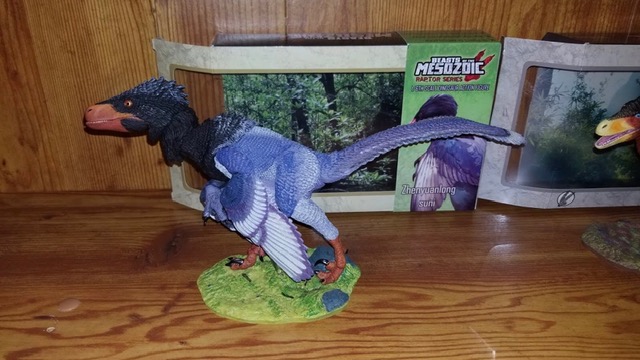
That all said, what is Cyberzoic you may ask? I imagine most here are at least somewhat familiar with the Beasts of the Mesozoic action figures. Following the success of the Raptor Series, Ceratopsian Series, and Tyrannosaur Series, it was time for something different. Enter the Cyberzoic, a brand new line with transforming armors, riders, dragons, and of course the prehistoric beasts. It was initially teased on the Tyrannosaur Series Kickstarter, which launched on September 22, 2021, with silhouettes of the armored Dryptosaurus, next to the Arctic Dragon. Another teaser was shared in update #35, with artwork of the Fire Knight riding the armored Dryptosaurus from artist Ross Persichetti. However the first look at the roster was not shared until March 2022, and among those was the Carnotaurus sastrei, the subject of review here. The Cyberzoic Kickstarter itself launched on October 3, 2023, and ended with over $600,000 raised. While I was unable to pledge for the Carnotaurus while the Kicktarter was still ongoing, I did sneak in a late pre-order for it on the Backerkit store, just before they started shipping out.

As far as the figure itself goes, the first look at the initial sculpt, done by Jake Baardse, was not revealed until much later in the year, in December. As far as I am aware this is the first figure to hit the market (or at least revealed) based on the detailed description of the integument in 2021 by Christophe Hendrickx and Phil Bell, but correct me if I’m wrong. The coloration of the figure is primarily based on the Argentine black and white tegu/Salvator merianae, but additionally the tiger as well. This was first revealed with the finished concept art done by David Silva in May 2023. There was an alternate color scheme for the Beasts of the Mesozoic designed in January 2024, but it has yet to make its way to a prototype, let alone in production. Anyways, as if I wasn’t already in love with the sculpt work, the colors really tickled my fancy. Despite being a paleo meme, I am a sucker for Carnotaurus in warm colors (I suppose the Disney Dinosaur Carnotaurus is to blame). This is mostly still a fresh take as it isn’t predominantly orange or red this time around, although it does somewhat remind me of the 1993 Kenner Jurassic Park Series 1 “Demon” toy, the first Carnotaurus toy released, due to the mix of black and warm tones. The finished painted prototype was teased on September 15 in an image showing the line up, but was not revealed in full until the Cyberzoic Kickstarter update #20 on October 30. This prototype was painted up by Matt Holt, and would then be on display at Legions Con in 2023. Thankfully I was able to go and see it in person, and you can bet it definitely held my attention while there (well aside from the Gorgosaurus, etc).


Before addressing the figure proper, what about Carnotaurus sastrei itself? It was first discovered in 1984 during an expedition sponsored by the National Geographic Society in the Chubut Province of Argentina. That expedition was led by José Bonaparte. If you read my prior Mattel Amargasaurus review, then this should all seem familiar, as both were discovered during the same expedition (though not from the same formation). Only one skeleton (holotype MACN-CH 894) has been discovered to date, but thankfully this specimen is nearly complete, missing only the lower parts of the legs, and much of the end of the tail, which had weathered away (the gastralia, or belly ribs, were also not present). It also preserved a decent amount of skin material (on its right side, with the largest patch from the tail), the most for any one theropod currently, some of which was unfortunately lost while it was being excavated and prepared from not being recognized at the time. Thankfully what has been spared still gives us a good idea of what it looked like. Carnotaurus sastrei was named a year later by Bonaparte in National Geographic Research, and it would be described in full in 1990 by Bonaparte et al. The genus name means “meat bull” in Latin, and the species name was named after Angel Sastre, the owner of the ranch “Pocho Sastre” where it was discovered. It hails from the La Colonia Formation, during the very end of the Cretaceous Period, 69 to 66 million years ago. Fauna includes turtles, snakes, lungfish, mammals, plesiosaurs (Chubutinectes, Kawanectes, Sulcusuchus, and an unnamed one), and other dinosaurs like an unnamed hadrosaurid (related to Kritosaurus, Rhinorex, and Gryposaurus), an unnamed parankylosaur (related to Antarctopelta, Kunbarrasaurus, Minmi, Patagopelta, and Stegouros, but with a distinctive cudgel shaped tail weapon), the small titanosaur Titanomachya, and the abelisaurid Koleken.


Before moving on to the figure proper, here’s a quick rundown on the packaging and its contents. The package art was done by Raph Lomotan. On the front is a look at the Carnotaurus without armor, and on the backside is with it wearing the Decimator armor, and Dybukk, the rider. The backside also features some information about the animal, and the two other figures intended to be used with this figure, as shown in the package art. The bottom of the package has the credits info, and the Cyberzoic Fire Clan logo is on the left side of the package. Aside from the figure and tail which needs assembled, is the parts for the stand, a pair of resting or relaxed toes, a pair of running toes, and three sets of alternate horns. The stand included is the large theropod display stand, though it also includes the alternate rod and clip from the medium stand set. As per usual with these figures there is also a wonderful background insert which can be used for display purposes. The Cyberzoic ones are dual-sided, with the first side having a red grid overlaid solid black, and the other side with the background featured in the package art. There is also a Zoic TCG card, sharing the package art on the front, and an image of the figure on the back. The package also measures about a little over 14 inches (35.56 cm) long, just shy of 5 inches (12.7 cm) wide, and 9.5 inches (24.26 cm) high.


Moving focus on to the figure finally, as mentioned earlier, the sculpt was done by Jake Baardse, who has contributed a number of sculpts to Creative Beast Studio. Rather interestingly he also contributed a sculpt of Carnotaurus for the 2021 paper from Hendrickx and Bell focusing on the skin material. It should be no surprise that he delivered once again here with the immaculate sculpt work, and largely spot on to the current understanding of the animal. It’s also worth mentioning Ross Persichetti designed the articulation for this figure, and he also sculpted the extra accessory horns (which was a late, but welcome addition in its production). Speaking of the articulation, it is fantastic for the most part (there are a few downsides for me, but I’ll dig into that later). Typically the joints might need warmed up before using them (particularly if they are stiff), but surprisingly I had no issues with working mine right out of the box without needing to do such.


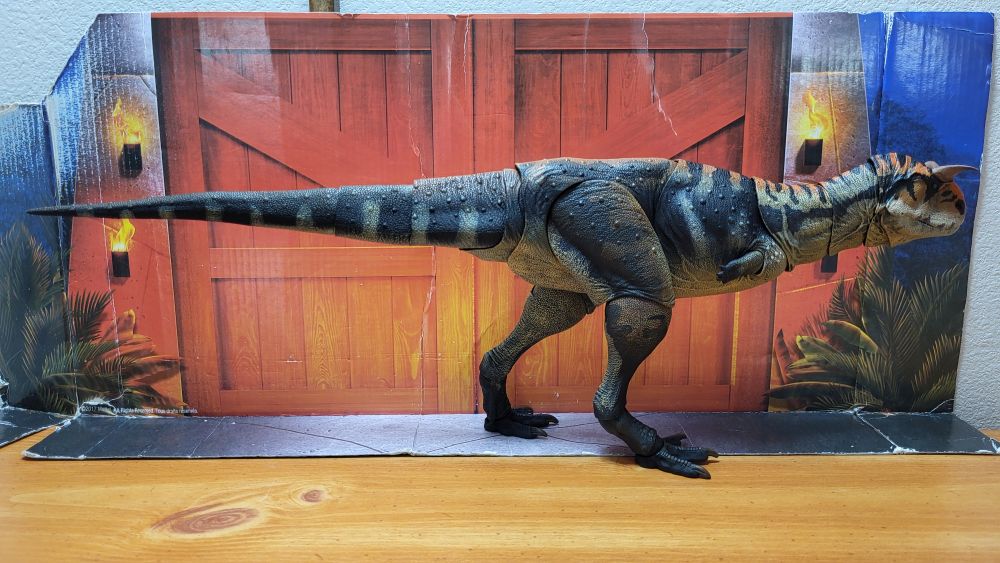
The figure when in a neutral pose, with neck, legs, and tail straightened out, measures roughly about 19.75 inches (50.16 cm) long, and about 7 inches (17.78 cm) tall from feet to hips. The current estimate for Carnotaurus is about 7.5 to 8 meters in length. This gives an approximate scale ranging from 1/14.95 to 1/15.9, which is a tad too big to be in the intended 1/18 scale. However it is worth noting the Carnotaurus was intentionally up-sized to be about 20 inches long (per Cyberzoic Kickstarter Update #25 on December 6), so the corresponding Decimator armor can be compatible with the Allosaurus, and Tyrannosaur Series body type 4 figures (such as Gorgosaurus, etc). Meanwhile using the recent size estimates for the related larger, but fragmentary Pycnonemosaurus, ranging from 8.9 to 9 meters in length, gives a scale of about 1/17.7 to 1/17.9 scale. This puts it safely near the intended 1/18 range. As Carnotaurus is only known from a sole specimen, who knows if other individuals may have reached this size. Considering the Cyberzoic line also offers an up-sized Smilodon (1/12 scale proper) due to genetic manipulation per the lore, I think a somewhat bigger Carnotaurus is reasonable. The head from the premaxilla (snout tip) to quadrate (just behind the ear holes), is roughly 1.75 inches (4.44 cm) long, which gives an approximate scale of 1/13.4 when using the measurements from the Cerroni et al (2020, supplemental).


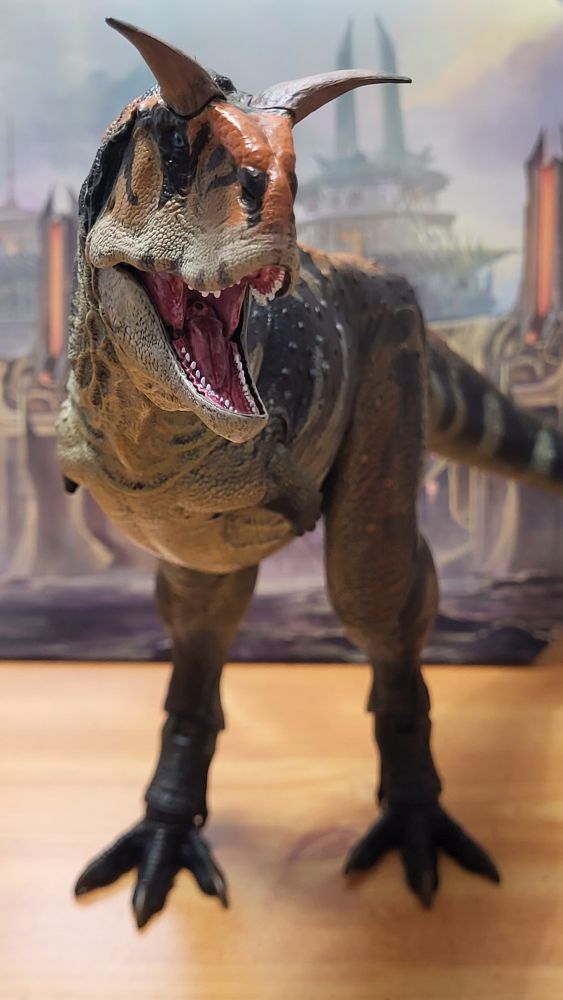
Focusing on the head itself, you first have the iconic pair of horns above the eyes. The long horns are installed by default, but there’s options for short, medium, and broken, each marked with R and L designating right and left. The skull itself is properly narrow from the front, and robust and short from the side, with the narrow lower jaw. Most of the head is covered in fine scales, although the horns and front of the snout have been depicted with a cornified (horny) covering (such as in Delcourt, 2018). The lower jaw opens up rather wide, and can close relatively flush. Worth noting that the upper oral tissue (or lip) on the right side of my figure has a tiny bit of warping, exposing the teeth slightly. I probably could have corrected this by using a hair dryer or hot water, but didn’t feel like it, considering it’s such a small area affected. The tiny tongue is also articulated. Carnotaurus is one of the few animals where the hyoid material preserved giving an indication of where the tongue was located, if not the size of it as well, so hopefully the shape and placement of the tongue is correct. There’s also a ring of scales around the eyes as inferred by Cerroni et al (2020). The ear holes are present, and the tiny holes, or choanae, connecting to the nasal cavity is present on the roof of the mouth.


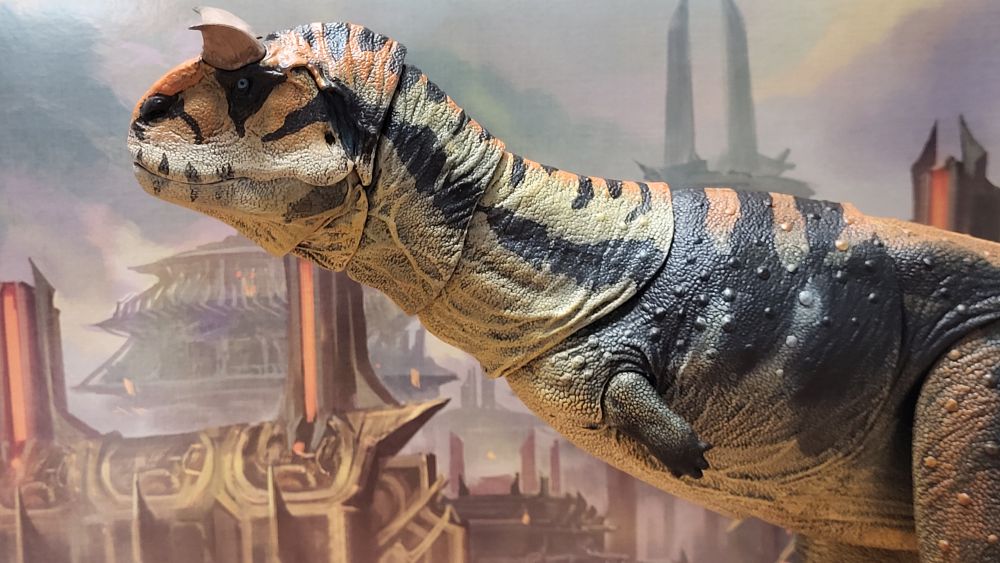
Moving on to the body there is a mix of fine scales (basement scales), and larger scales (feature scales) distributed randomly about (which is to say, based on the current fossil evidence). Prior reconstructions had these organized in rows, with some even depicting them as osteoderms such as in Disney’s Dinosaur and Jurassic World Fallen Kingdom. This is now known to be incorrect. The neck has three different joints of articulation, one at the base of the head, one in the middle of the neck, and the last at the base of the neck. There is a decent amount of side to side movement, and very good upwards movement as well. Now for the first drawback, there is very little downwards range. It appears that the Allosaurus and things like the upcoming Ceratosaurus have more range in this area in comparison. Still with enough effort, and utilizing each of the neck joints, alongside the torso and hip joints, one can still put this into a ramming pose if desired (such as based on the attack animation in Ark: Survival Evolved), or eating, etc.


The forelimbs are correctly small, lack an elbow and wrists, and also lack claws on the digits. There are four digits, and they are shaped correctly as well, with the first being the shortest, and the fourth being the longest, which also points away from the other digits. The arms can move in and out quite a bit, which is great, but does have limited rotation due to the shape of the surrounding shoulder. This is another drawback for me, and I wish it had full 360 degree rotation in this area. One can sort of replicate the silly pose featured in Prehistoric Planet if one so desires, but it might not be to the fullest extant as seen in the show. Per Senter and Parrish, 2006, when the humerus is protracted the palms of the hands should face towards the skull, and when retracted the hands should face ventrally. Additionally the first digit should be facing away from the body (lateral), whereas the fourth digit should be facing towards it (medial). Due to the lack of articulation in this area, it is hard to achieve this without either popping the arms off, or perhaps softening the surrounding plastic of the shoulder first. However it is worth noting that most reconstructions of Carnotaurus out there do not follow this, perhaps due to this information not being readily accessible.


The torso joint is what one would come to expect with these figures, with some side to side, and up and down movement. The proportions of the hind limbs seem to be a mix of Carnotaurus proper for the upper half, and perhaps based on other abelisaurids related to it for the lower half (such as Aucasaurus), as those elements are not known. The hip joints have a nice range of rotation (360 degrees if one really desires it), along with some wide in and out movement. The knee joints are standard fare with these figures, but these seem to have a little bit more inwards range this time around, than on some of the prior figures, allowing for a near perfect 90 degree bend. They can also be rotated around. The ankle joints and toes use the disc joints that are now standard for any theropod released post Tyrannosaur Series, making them far more stable (allowing it to be displayed without the stand), giving more range, and making it a breeze to swap out the alternate toes for certain poses (which are also marked with R and L for right and left, like with the horns). Both the ankles and toe joints have decent up and down range, and of course rotation as well if required. Altogether the hip, knee, ankle, and toe joints allows for anything from walking, running, and even a sitting posture. In particular I’m glad that it can nearly replicate the beloved adorable Jurassic World Evolution 2 sitting posture, something I was truly hoping it could pull off long prior. Rather interestingly, the figure has been given a cloaca, which many of the prior figures appear to have lacked (excluding those covered in plumage of course).


As far as I’m aware, this is the first figure from Creative Beast Studio released so far to feature a new type of joint at the base of the tail allowing for an expanded range of movement up and down, and side to side. The upcoming Acrocanthosaurus and T. rex v2 for example, seem to feature this style of joint system as well. There is a noticeable seam or cut on the tail itself with a separate piece made out of a softer plastic or rubber that the cloaca is present on. This does not seem to be an extra articulation segment, but seems to act as a cover for the joint, as the top and sides are flexible, and may shift around slightly depending on the pose of the joint, while the bottom part seems glued on. This difference in material perhaps aids in the amount of range the tail can achieve. The tail can also rotate around quite a bit as well. There are an additional two joints in the tail, and of course the standard bendy wire tail, allowing for a great variety of posing. Many recent reconstructions of Carnotaurus based the tail (and leg) musculature off of the 2011 “Dinosaur Speed Demon” paper from Scott Persons IV and Currie, which reconstructs the caudofemoralis muscle (a leg muscle forming part of the tail) as being quite large. From what I can tell, the proportions of the tail’s sculpt appears to be in between the robust and conservative model reconstructions provided in the paper. However the Skeleton Crew (a group of paleontologists) recently released a counter to this paper, that no, Carnotaurus was not a fast runner, and that there were issues with how the models were reconstructed in that paper (such as incorrectly attaching the caudofemoralis to parts of the vertebrae that stick out called the transverse processes, among other things). Without doing further extensive research on this, I think perhaps what’s here is still possibly within reason (if with a grain of salt).


Now on to the coloration, which dare I say is immaculate and among the best out of any figure from Creative Beast Studio so far. It also looks pretty darn metal too (which is further aided by the horns the animal sported). As mentioned earlier the coloration and patterns were derived from a mix of the Argentine black and white tegu and tiger, though it is the tegu which forms the basis for the majority of the pattern work. There is a mix of orange and black markings and stripes on the head, and running down the neck of the figure, which is no doubt where the tiger inspiration comes into play, while a cream color covers the jaws and neck. This cream color gradually darkens to more of a tan or brown color down the belly. There’s quite a bit of a wash on the underside as well, bringing out the fine scales throughout. The black stripes lead to the predominantly black body. Light grey stripes fade on the sides of the torso and down the tail. There’s also a mix of a rusty brown color on the legs, which eventually fades to black going down the rest of the legs and feet. The horns are a tan or light brown color, and there’s also a tiny bit of olive coloring in between them. The inside of the mouth is painted pink, with a nice gloss coat giving it that wet look. The eyes are a piercing cold blue, contrasting heavily with the surrounding black and warm tones on the rest of the head, and one of my favorite aspects about the coloration.

row 1: Gorgosaurus, Tarbosaurus, Carnotaurus
row 2: Utahraptor, Dilophosaurus, Yutyrannus, Lythronax
row 3: Guanlong, Proceratosaurus, Suskityrannus, Qianzhousaurus, Alectrosaurus
row 4: Velociraptor mongoliensis (bearded vulture), Velociraptor osmolskae (blue/scrub jay), Velociraptor mongoliensis (black), Dromaosaurus (goshawk), Fan’s Choice Dromaeosaurus (kestrel), and Linheraptor

row 1: Cyberzoic Carnotaurus, 2024 Hammond Collection Carnotaurus, 2018 Fallen Kingdom Action Attack Carnotaurus
row 2: 2025 Rebirth Aucasaurus
row 3: 2020 Primal Attack Majungasaurus, 2022 Dominion Owen Escape Pack Carnotaurus
row 4: 2025 Chaos Theory Guemesia
Despite owning this for a short time, this is by far and large one of my top favorite figures ever produced from Creative Beast Studio, and I have been supporting them since the start of the Beasts of the Mesozoic line 10 years ago with David Silva’s very first Raptor Series Kickstarter campaign. I am truly amazed at how far this line has come in all this time, and can hardly believe where things are now. I absolutely urge anyone that loves Carnotaurus, if not articulated dinosaurs in general to pick this one up. The cost could unfortunately be a bit prohibitive for some, I will not downplay that, as the MSRP is $129.99 (though was somewhat cheaper during the prior lengthy pre-order period since the Cyberzoic Kickstarter ended) The price may vary for other regions. It is available at Creative-Beast (US), Dinosaur Crates (Canada), Everything Dinosaur (UK), Speelboer (Netherlands), Lana Time Shop, and Big Bad Toy Store (US) currently.
 All articles on the Dinosaur Toy Blog are written without the use of 'AI'
This is one of the figures that makes me want to start collecting these. Along with the Pachycephalosaurus, Cryolophosaurus, Acrocanthosaurus, and Spicomellus.
Very brilliant Scientific research.