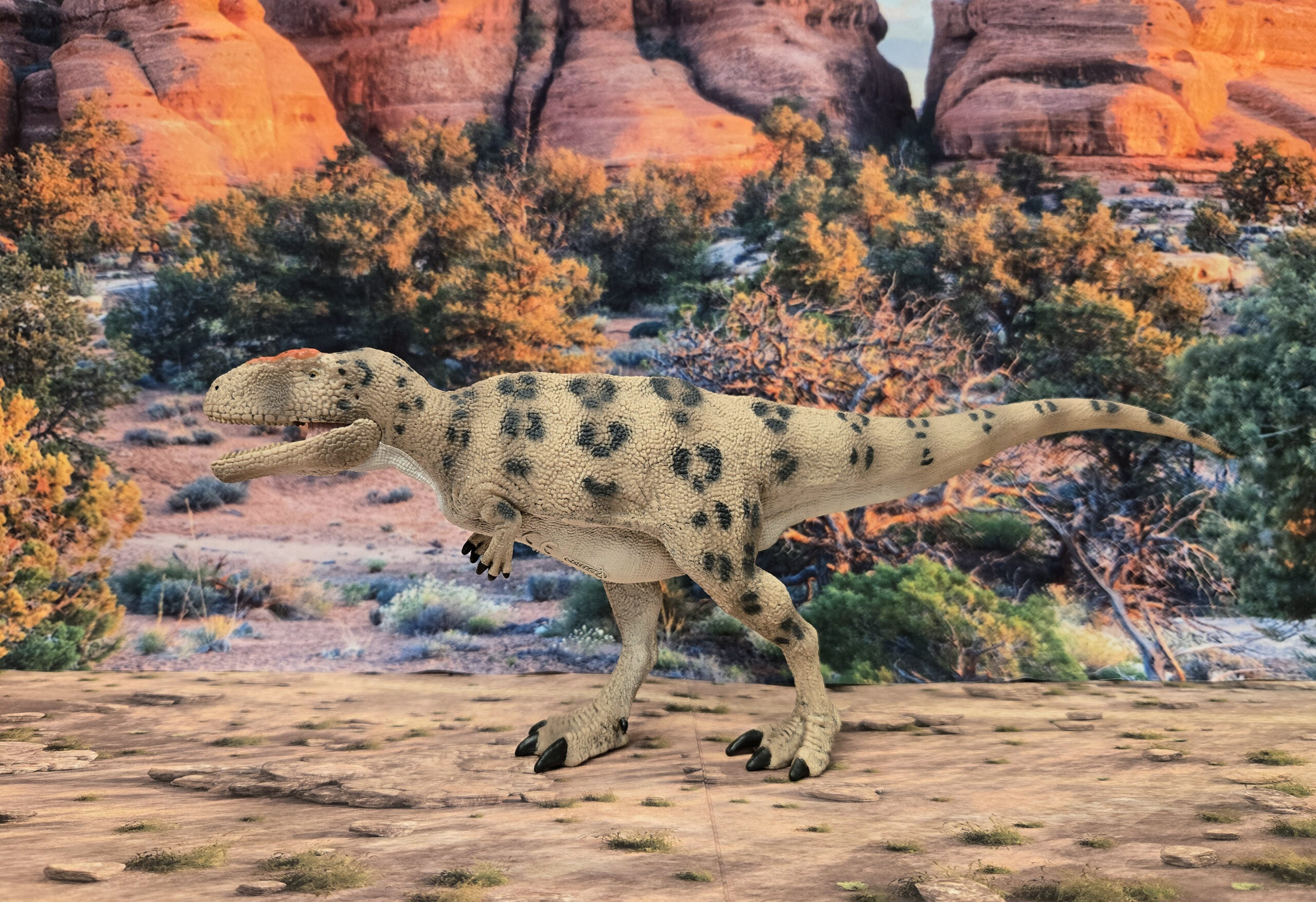
Before I start my review, I must thank our friends and colleagues at Happy Hen Toys for sending along this review sample. If you are in the United States, Happy Hen Toys is the place to go for all your prehistoric pals in plastic!
Meraxes was one of three legendary dragons used during Aegon’s Conquest, the campaign in which Aegon...
The Ediacaran is the first geological period with widespread evidence of multicellular life. And those fossils are actually quite extraordinary, as many of them are of soft-bodied creatures that normally do not preserve easily in the fossil record. Most of the fossils are casts and molds in sandstones. One theory for this is that their preservation may have been assisted...
The Tully Monster. Tullimonstrum gregarium. What was it? Ever since fossils of this marine predator were first discovered in the Mason Creek formation by amateur collector Francis Tully, paleontologists have been baffled trying to decipher its phylogenetic placement and relationships. It has bounced back and forth between invertebrate and vertebrate and at one time or another has been linked to...
Shantungosaurus giganteus, as its name suggests, was a monster of a hadrosaurid from the Late Cretaceous of China. It is known from a handful of incomplete skeletons. Shantungosaurus may be the sister genus to the American Edmontosaurus. Two other genera, Zhuchengosaurus and Huaxiasaurus, appear to represent ontogenetic and polymorphic variation of S. giganteus. The animal’s habitat was warm, wet, and...
In the last several years, the toy dinosaur community has seen an exponential increase in figures of dinosaurs discovered in China, driven mainly by the prolific China-based companies PNSO and Haolonggood. Today we looking at the first dinosaur seriously scientifically investigated from China, the sauropod Euhelopus zdanski of the early Cretaceous. Fossils were first discovered by a Catholic priest in...
The genus Jaekelopterus contains two species from the Early Devonian; fossils of J. rhenaniae were originally discovered in the Rhineland of Western Germany while those of J. howellii were originally discovered in Wyoming, USA. Jaekelopterus rhenaniae is not only the largest eurypterid, it is the largest known arthropod…EVER! Using a chelicera (claw) as a metric, J. rhenaniae was estimated as...
Before I start this review, I would like to thank our generous friends at Happy Hen Toys for providing this review sample. Of all of Haolonggood’s 2024 releases, this is the one I was most excited for, so I am honored to have been able to receive it as a gift.
Since moving to Utah in 2016 and collecting dinosaurs...
Review and photos by bmathison1972, edited by Suspsy.
In 2016, I moved from the hot and humid deciduous forests of Georgia to the hot and dry high deserts of Utah. It wasn’t a stark change for me, though, as I grew up in the hotter and drier Sonoran Desert of Arizona. Utah has produced many spectacular dinosaur species, especially those...
Review and images by bmathison1972; edited by Suspsy
Sinoceratops zhuchengensis is a centrosaurine ceratopsid that lived during the Late Cretaceous of present-day China. The holotype specimen was discovered in 2008 from the Hongtuya Formation in Shandong Province and was formally described in 2010. It was the first ceratopsid formally described from China! The holotype specimen includes a partial skull with...
Review and images by bmathison1972; edited by Suspsy
Dreadnoughtus schrani is a titanosaur from the Late Cretaceous (Campanian to Maastrichtian) of present-day South America. Remains of only two individuals have been described to date, both from the Cerro Fortaleza Formation in Argentina. Dreadnoughtus was one of the largest dinosaurs; estimations put its total length at approximately 26 meters and its...
Review and images by bmathison1972; edited by Suspsy
Prehistoric and primitive hominids are not rare in the animal toy market, but evolutionary sets of them are. The first, and probably the most popular, was called Evolution of Man, produced by Bullyland in 1999. The set featured Dryopithecus, Australopithecus, and four species of Homo: H. erectus, H. habilis, H. neanderthalensis, and...
Review and images by bmathison1972; edited by Suspsy
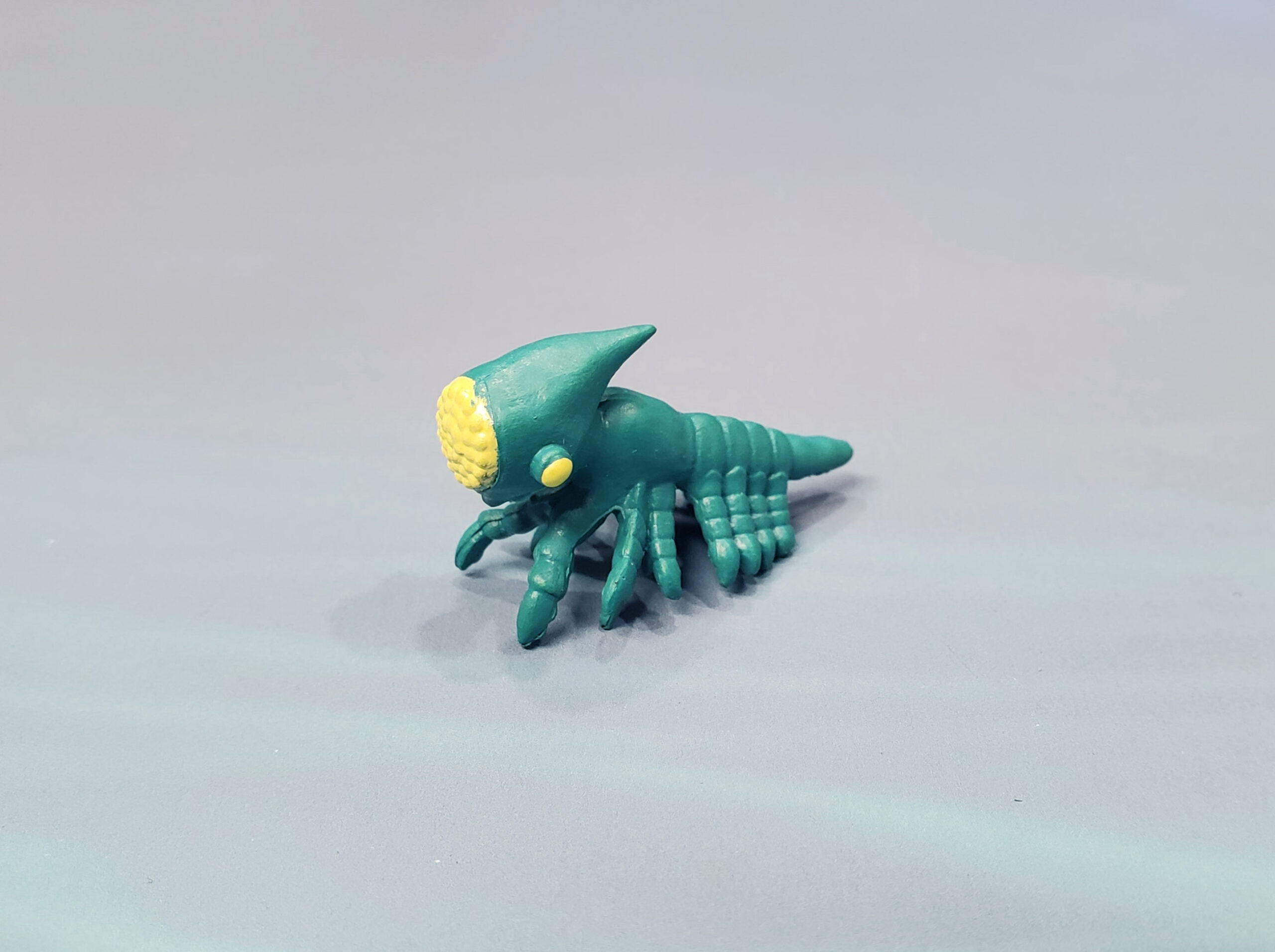
Goticaris longispinosa is a tiny, enigmatic arthropod originally described from both immature and adult forms from the Orsten Lagerstätten (Upper Cambrian) of present day Sweden. It was originally described as an early offshoot of the clade Pancrustacea but is now considered stem-group Mandibulata outside of Pancrustacea. Its bizarre morphology will be discussed...