



This year has been an exciting one for Haolonggood collectors as it has seen the company broaden its horizons and release a range of non-dinosaur prehistoric animals. They include a few Cenozoic mammals and the model we’re looking at today, a Sarcosuchus. Sarcosuchus is an early Cretaceous crocodyliform that superficially looks like a gigantic gharial but belongs to a clade outside of Crocodilia, to which all extant crocodilians belong. Sarcosuchus is known from the Elrhaz Formation in Niger, Africa. It lived alongside well-known dinosaurs such as Nigersaurus, Ouranosaurus, and Suchomimus, as well as other Crocodyliformes, such as Anatosuchus, and Araripesuchus.
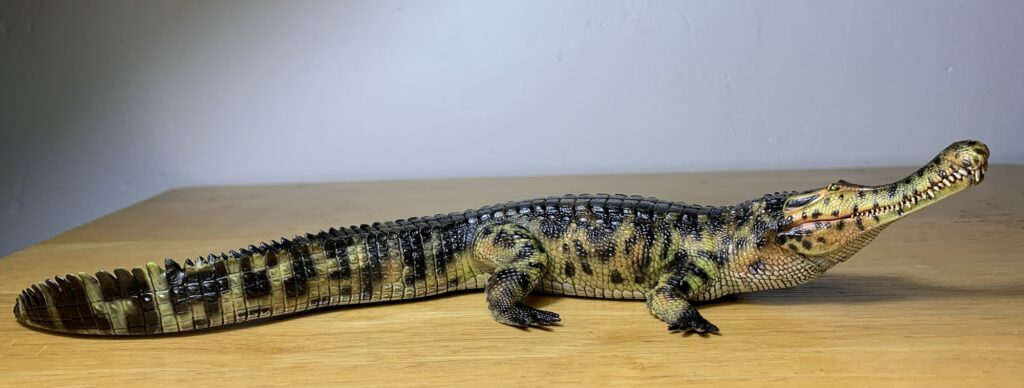
The Haolonggood Sarcosuchus measures 11.5” (29.21 cm) long along its various curves while the actual Sarcosuchus reached a staggering 31.2’ (9.5 meters), making it one of the largest known pseudosuchians. This puts the Haolonggood figure at 1/32 in scale. To be 1/35 it would have to be scaled down from a specimen measuring 34’ in length.


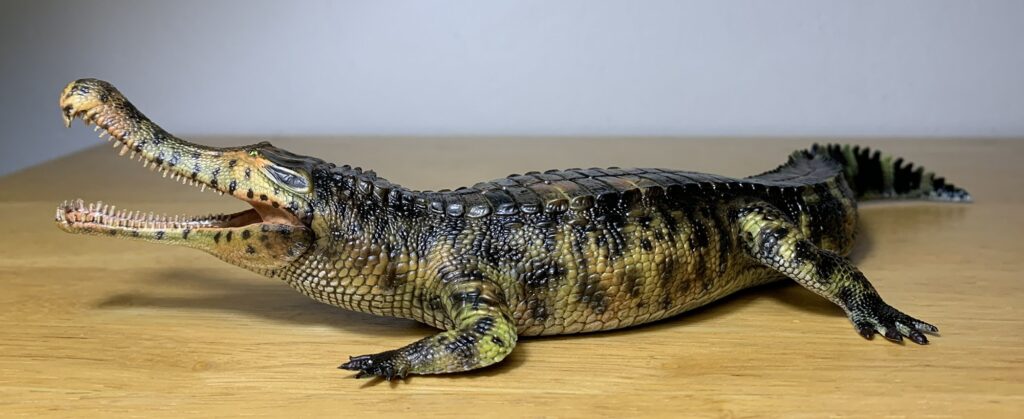
Haolonggood’s Sarcosuchus is presented in a relaxed pose, resting on its belly with the limbs splayed out, as if basking along the riverbank in the morning sun. The tail is positioned in a gentle S-curve, and the head is lifted and looking slightly rightward. The jaw is articulated and works seamlessly.


The figure possesses a long, slender snout with a slight overbite and bulla on the end, which is similar to the ghara that gharials have but unlike the ghara does not appear to be a sexually dimorphic trait. All Sarcosuchus specimens have it whereas in gharials, only the males do. There are about 26 teeth on each side of both the upper and lower jaw when there should be 35 on each side of the upper and 31 on each side of the lower jaw. It’s nitpicky to worry about the tooth count in my opinion but I’m just being thorough. The teeth are exceptionally sharp and thin and mostly alternate in size. In the very scientific method of holding the figure up to a picture of the skull on my screen the head appears accurately shaped.


The eyes are small and perched high up on the head with the temporal fenestra obviously displayed behind them with somewhat indented plates of armor. The pebbly scales over the head are exceptionally fine with some larger scales clustered on the back of the mandible. The inside of the mouth is textured with grooves and ridges but there doesn’t appear to be a tongue. It could be that the tongue is implied and just being held flush to the jaw, as is the case in extant crocodilians.


The neck is deep and broad and the body is somewhat flattened and wide. The base of the tail is thick and broad and gradually tapers off into a laterally compressed tip. Five clawed digits are sculpted on the forelimbs and four on the hindlimbs. I’m not sure what the consensus is on how many digits had claws but they’re hard to see anyway. Along the back, the dermal scutes are accurately wide and rectangular, with keels on their lateral sides and additional details in the form of small grooves, ridges, and indents. These keels merge into triangular scutes on the tail. Oval osteoderms run along the sides of the body, alongside the edge of the dermal scutes. Rows of flattened, square shaped belly scutes run along the underside of the figure.


Elsewhere on the body you get a covering of scales that conform to different parts of the body in a way you would see on extant crocodilians. There are some raised tubercles around the nape, pebbly scales over most of the body, square shaped scales on the limbs, and square shaped scales along the tail that are individually keeled. The scutes around the cloaca are smaller than the rest on the underside and match closely with those seen in extant crocodiles.


The fact that this figure is so heavily inspired by extant crocodilian anatomy works greatly to its benefit. This has to be Haolonggood’s most realistic figures yet and if photographed in the right setting could probably convince someone that it’s a real, living animal.


This Sarcosuchus comes in two different colors. Tong Wei is green while Tong Meng is brown. The green one is unbelievably striking but it seems that the brown one might be more popular. Collectors seem to be holding out for a green Deinosuchus and think brown is a better fit for a Sarcosuchus. For my collection I couldn’t help it, green was the way to go. Of course, the figure isn’t just green. Bits of brown are nicely blended in on places, like along the sides of the jaw and neck, and the belly is a mix of dirty looking grays and pale green.


The dermal scutes are a mix of black, dark green, and brown. Black spots are painted along the snout and larger black blotches run along the sides. Black bands run along the sides of the tail and nicely follow the edges of the scales, creating a pixilated like pattern. The hands and feet are black, and the inside of the mouth is glossy pink with a dark wash. The teeth are white and the eyes are bright green with black pupils. The entire figure has a glossy sheen that makes it appear wet, as if it just hauled itself out of the water. The paintjob is a believable one that brings to mind extant crocodilians while not directly copying them. The bright green tones contrasted against the black markings really make the figure pop.


The Hoalonggood Sarcosuchus is an absolute masterpiece. It is sufficiently accurate to the real animal and thanks to being heavily inspired by extant crocodilians it brings this prehistoric croc to life in a way that’s seldom accomplished by a conventional figurine. It genuinely looks like a living, breathing animal. It is a must have for any collection that emphasizes the fusion of art and science to deliver lifelike prehistoric animal figures.

 All articles on the Dinosaur Toy Blog are written without the use of 'AI'
I’m also on team green. I just got mine in this week but I haven’t opened the box yet…saving it for the weekend! Great review.
Thanks! I look forward to seeing yours in your collection thread.
This beauty is the first Crocodilian addition to my 1/35 dino-collection. The green one is PHE-NO-MENA-LLY lifelike!
5 STARS – best ‘Pre-Croc’ figure anyone has made to date!
Another HLG ‘Homerun’!!! 🙂
Excellent review!
I bought both, which arrived yesterday, and I must say, they are very impressive!
The teeth are quite sharp, too!
The green one really is my favourite, it is just more pleasing to my eye.
Thank you!