



While Anomalocaris takes the number one spot for my favorite Cambrian period invertebrate, Opabinia is a very close second, due to its enigmatic anatomy, featuring a strange proboscis, five eyes, and with a body shape that is similar, yet distinct from Anomalocaris and kin. I was of course delighted when I saw that it was part of the From the Shale Plushies lineup last year, and here we are now with Bini. My deepest gratitude to paleontologist Brennan Martens (BrennanThePaleoDude) for sending this one out to me. Before addressing the plush itself, here’s a little history on this ‘weird wonder’, as Stephen Jay Gould once addressed it in his 1989 book Wonderful Life.

Opabinia regalis is another one of the many delightful animals from the famous Burgess Shale located within British Columbia of Canada, and lived over 500 millions years ago. It was first named and described by Charles D. Walcott in 1912, after the Opabin pass between Mount Hungabee and Mount Biddle. The first specimens of it were recovered in 1909 by him and his wife, along with a number of other organisms including the plentiful Marrella, but also Amiskwia, Burgessia, Canadia, Naraoia, Pikaia, Waptia, Wiwaxia, Yohoia, among others. Walcott initially described it as a crustacean, belonging to the order Anostraca, otherwise known as “fairy shrimp”. The very first in-life reconstruction of the animal was in 1930 by George Evelyn Hutchinson, swimming upside down, following Walcott’s interpretation of it being an anostracan. More reconstructions followed, first in 1970 by Alberto Simonetta, notably lacking the distinctive five eyes, and later in 1975 by Harry B. Whittington. It is however Whittington’s work that has since formed the basis of the current understanding, and interpretations of its anatomy that have since followed. Whittington also significantly contributed to paleontology on the Burgess Shale, and the understanding of the Cambrian Explosion outside of just Opabinia, much like Walcott prior, but it is the subject matter here after all.
He disagreed with it being an arthropod however, but in 1986 Jan Bergström took notice of the anatomical similarities shared by it and Anomalocaris, the latter which had shown indication of being an arthropod with its anatomy, and had inferred that Opabinia was as well. Derek Briggs and Whittington disagreed with his conclusions in 1987, and Bergström responded back. Enter Kerygmachela kierkegaardi, which was described by Graham Budd in 1993. This strange animal helped shed further light on the taxonomic affinities between Opabinia and other arthropods, which Budd went on to publish in 1996. Later research since then has helped shed a better understanding that it is indeed an arthropod, and closely related to the Radiodonta, the order that Anomalocaris belongs to. As of 2022 it is now no longer the sole member of the family Opabiniidae, with Utaurora comosa from the Wheeler Shale of Utah (Pates et al), and potentially Mieridduryn bonniae, from the Castle Bank of Wales, the latter from the later Ordovician period as well (Pates et al). Another puzzling animal that bares some similarities is Kylinxia zhangi, named in 2020 (Zeng et al).


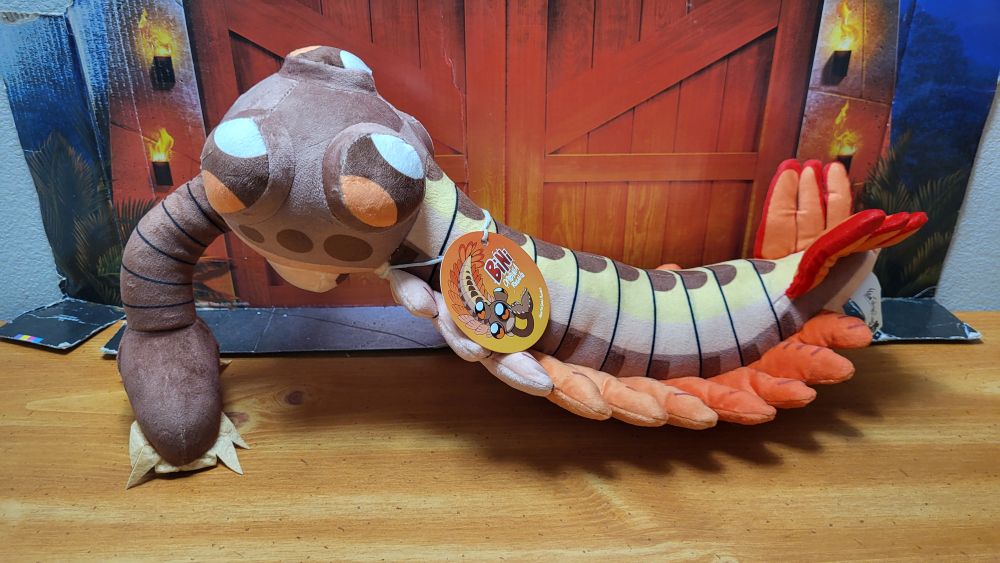
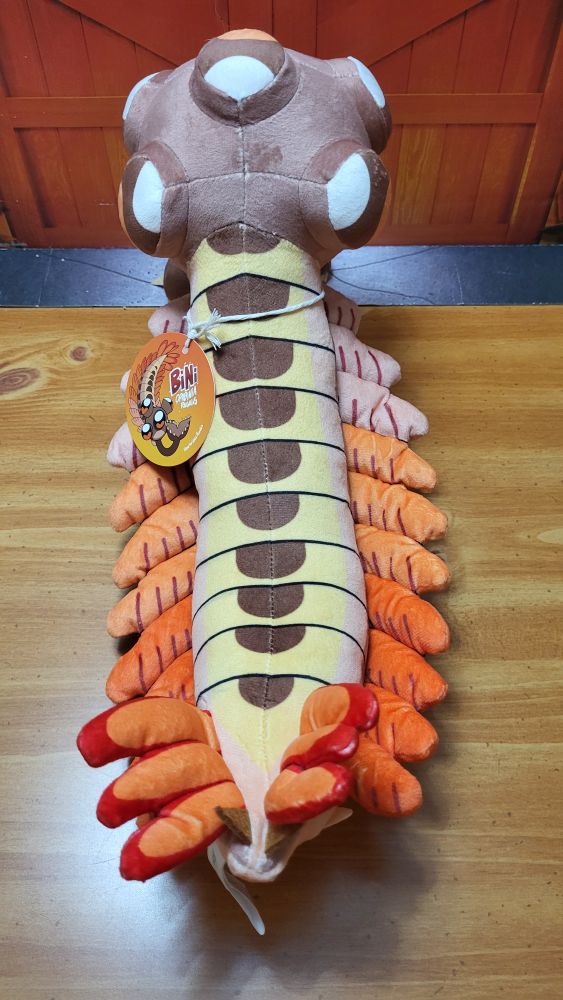
As for the plush itself, this was designed by both Brennan and paleo artist Royce Riturban (Saureal), and is the third plush to finish production for their From The Shale Plushies brand after Carri the Anomalocaris, and Fry the Knightia. It is however the first of the Burgess Shale series, which is also planned to feature Hallucigenia sparsa, Olenoides serratus, Pikaia gracilens, and Wiwaxia corrugata. Most of the plush is a mix of orange, peach, and brown, which contrasts nicely to Carri the Anomalocaris I reviewed last year. The plush is also of course larger than life size, measuring about 35.6 to 36.8 cm long (14 to 14.5 inches), as specimens range from 4 cm (1.6 inches) to 7 cm (2.8 inches), without the proboscis included in either of these measurements. The plushie is about 16.5 cm (6.5 inches) at its widest. It is worth nothing however that the head does seem to be a bit larger proportionally, although it adds to the charm factor for me.

As far as the anatomy goes, starting from the head, five eyes are correctly present, although I think the back two eyes should be somewhat larger, and the two front eyes could be a bit closer together. The eyes stalks could perhaps be a tad longer. They do seem to be positioned correctly from what I can tell. The proboscis appears to be segmented in a simplified manner, and does end with the grasping claw-like structure, and does include the spines at the edge of the claw as well. There are five spines on each side, and the middle one is rather wide. I wonder if this was due to the constraints of being a plushie however (same for the eyes as well). The mouth is correctly positioned underneath the head and facing towards the body, and seems to have an indication of being tube shaped, but again simplified by being sewn up against the head.

The body has fewer segments and flaps than the fossil evidence suggests, having only 10 instead of 15. Carri was similar in this regard, also having fewer. I’m not sure if it is a stylistic choice, or a constraint with being a plushie, but worth addressing regardless. Each of the flaps has striations upon their outer edges which may be representative of the gills. The placement of which seems in line with most reconstructions, which have varied from one interpretation of the material to the next. On the underside of the body are a number (10 to be exact) of rounded triangular-like structures. The interpretations of these has varied in the past as well, but the most current seems to be that these are lobopods, or lobopodous limbs (like a velvet worm’s limbs) per Budd and Daley’s 2011 paper (Budd also came to a similar conclusion in his 1996 paper). Similar structures may have been found with the lone specimen of Utaurora comosa, but it was one of several possible interpretations based on the poor nature of them (others included broken off bits of swimming flaps, or artifacts from the matrix). The related Mieridduryn bonniae (rather directly within Opabiniidae, or outside it) has appeared to preserve with them. The end of the body does end in a cone shaped tail-like structure with three pairs of fan blades, although they are mostly uniform in size. The first pair of such (closest to the body) should be the largest. At the very end of the tail structure are two tiny triangles, no doubt representative of the spines present there.


With a few notable exceptions with the anatomy here and there, this is a largely well informed reconstruction of Opabinia. For anyone that missed out on the prior Paleo Pals Oakley plushie from a few years back, I’d highly recommend picking this one up, which you can do at the From the Shale Plushies Etsy store, which in turn can help support the line to grow further. As far as other Cambrian period plushies in the line currently available, there is of course Carri the Anomalocaris I mentioned earlier (and as seen in the first comparison image above), and Nelly the Olenellus santuccii (trilobite) which should be shipping out soon (still available to pledge for over on the kickstarter). One last thing I’d like to mention is that I referenced the reconstruction from Prehistorica (Christian M.), as well as this wonderful read by Derek Briggs on the history of research on Opabinia, and Whittington’s work, in addition to the other papers I’ve linked above throughout.
 All articles on the Dinosaur Toy Blog are written without the use of 'AI'
very scientific and well written.