



Before we begin the review, I would like to extend my gratitude towards Happy Hen Toys for sending this figure along as a review sample. Check out their large selection of animal and dinosaur figures by clicking the banner below.

With 121 reviews, Triceratops is the second most reviewed genus on the Dinosaur Toy Blog. Much like the dinosaur that takes the number one spot, Triceratops is a dinosaur that has been produced ad nauseum by toy companies, to the point where it takes something really special to pique the interest of collectors. For my own collection, I have been content with the 2018 Safari Ltd. Triceratops as the modern representative of the genus in my collection and felt little reason to get another… until Haolonggood announced their take on old three-horned face. With the Haolonggood Triceratops it was clear that the company approached this much beloved dinosaur with an extra degree of attention and care.


Even though Triceratops toys are frequent and abundant they almost all represent the same species, T. horridus, but there was another species that has been neglected by toy companies and sought after by collectors, T. prorsus. The slightly younger T. prorsus can be differentiated from the older T. horridus by its longer, more forward pointing nasal horn, and a shorter and deeper muzzle. Because it somewhat displays the features of T. prorsus, many have hailed Haolonggood’s Triceratops as being that often neglected species, but it is more complicated than that.


With its incredibly long brow horns, Haolonggood’s Triceratops appears to be based on MOR 3027, otherwise known as Yoshi’s Trike. Named after its discoverer, Yoshi Katsura, MOR 3027 is a subadult Triceratops that had brow horns measuring 3’ 9” (1.15 meters) and with the addition of a keratin sheath would have likely had horns over 4’ long, the longest horns of any Triceratops specimen. This is the Trike that Eofauna’s is based on and there was a Trike on Prehistoric Planet that appeared to have been inspired by MOR 3027 as well. Because it was found in layers between the two species of Triceratops, and displays features of both species, it is thought that Yoshi’s Trike is an intermediate form between the two. This would mean that Haolonggood’s Triceratops cannot be identified at the species level or could represent either one of them, if you so desired.


Haolonggood’s Triceratops stands 4.5” (11.43 cm) tall to the top of the frill and measures about 10” (25.4 cm) long when measured along its curves. The figure is advertised as being 1/35 in scale and it is if scaled down from a length of 29’. Triceratops reached a length of 26-30’ (8-9 meters). Scaled down from the 20’ length estimated for Yoshi’s Trike gives us a scale of 1/24. For the horns to match that 1/24 scale they would have to have measured 5’ in life, which really isn’t a huge stretch of the imagination. No matter how you slice it, this is a massive toy.

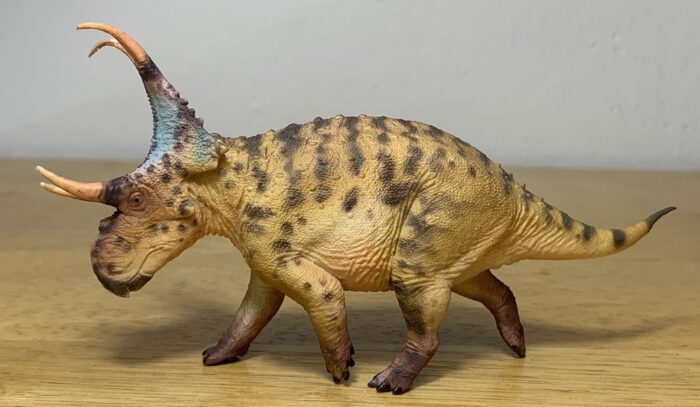
The figure is posed with a decent amount of dynamism, for a Haolonggood figure anyway. It is sculpted striding along with the head lifted high and turned slightly to the left. The tail dips down and curves towards the right. It has an air of confidence about it, as if it’s surveying its territory and knows it’s in its prime and safe from even the mightiest of tyrant lizards.

While the details on many Haolonggood figures get lost in the paintjob or are too fine to appreciate, the details on here are very clear and crisp, with even the smallest scales being individually defined and easily discernable. Starting with the head, we see fine scales on the end of the muzzle and over the fenestra that gradually transition to larger scales elsewhere on the head. Clusters of large scales can be seen on the base of the lower jaw and the largest scales are sculpted over the frill. In fact, the frill has large plate-like slabs of scales or keratin where the fenestra would be if this were a genus that had openings in the frill (Triceratops had a solid frill). There is no evidence for structures like these on Triceratops, although we do know that scales covered the frill.


The keratinous bits on the head are nicely textured with faint grooves and ridges, and I especially like the rippled texture on the base of the brow horns. The brow horns are connected to the orbits, nasal horn, and beak via a sheet of keratin that probably isn’t accurate, but I like it anyway. Notably, the back of the frill is practically devoid of detail. All that’s there is some faint wrinkling. To the best of my knowledge, all other Haolonggood ceratopsians have had scales on the back of the frill and in my reviews, I always praised them for that, especially since PNSO often leaves the back of the frill blank despite the higher price tag.

The body has a wide and bulky build and is covered in fine scales with larger feature scales scattered throughout. Different sized scales correspond with different parts of the body with larger scales along the back and over the shoulders and thighs, small scales along the underside, and positively miniscule scales in places like the hands and feet. Scutes are sculpted running down the fingers and toes and this includes the reduced digits on the hands, which are accurately clawless.

Nostrils and a cloaca are present but there are no ear openings, a curious oversight but a small detail that’s absence is easy to wave off. As previously stated, each scale is sharply defined and individually discernable. Each segment of the body is its own piece of meticulously detailed art, allowing you to enjoy the entire figure from afar or close up.


As usual, this figure comes with two different paintjobs. Hu Yan Zhuo is gray while Qin Ming is green. Although Haolonggood typically uses the same patterns with different colors for each variant, that is not the case here. Each figure has its own unique pattern. The green Trike has dark horizontal bands on the front half and a chain-like pattern over the thighs while the gray version has thick vertical stripes along the back and legs. Both figures are beautiful and I had no real preference over which I wanted but did find myself leaning towards the gray variant. The gray Trike seems more unique and original versus the green, which has been used before by Haolonggood.

To call Hu Yan Zhuo “gray” is a bit of an understatement because like all Haolonggood dinosaurs, the paintjob is extremely complex with a lot of subtle little changes of tone. The gray used is darker dorsally and has a tan wash over the flanks that transitions to a mostly pink underside. Although I’m tired of striping on dinosaurs these stripes are more like thick bands with soft edges that blend into the gray base color, giving the paintjob a rippling effect.


On the head the grays start to lean into the blue spectrum and there are pink highlights on the fenestra and frill. Brown stripes and speckles beautify the face and vibrant orange spots over the frill emphasize its function as a display feature. The horns and beak are dark gray at the base and fade into an orange-brown that fades to tan tips on the brow horns. The back of the frill is again treated as an afterthought, with a simple brown and gray mottled paintjob. The claws are black and the eyes are yellow with black pupils.


Although I’m not a fan of the weird plates on the frill and its unfinished backside those faults are not enough to sway me from declaring this one of the best Triceratops figures ever made. With its stunning paintjob, crisp details, and imposing size and weaponry, this model breaths new life into a classic dinosaur that it being increasingly overlooked in favor of other ceratopsians. This will quite possibly be the last Triceratops figure I ever add to my display cabinet. You can get yours over at Happy Hen Toys by clicking here.
 All articles on the Dinosaur Toy Blog are written without the use of 'AI'
I find this Haolonggood Triceratops to be absolutely gorgeous. They’ve done an incredible job with the sculpt, truly capturing how imposing and powerful this animal would have been. As far as static scientific models go, this remains my absolute favorite.
I got the green version a couple months ago, and I couldn’t be happier with this figure. Its size and vibrance radiate aura, and it stands out in the best way possible.
The green version was the last ceratopsian that I’ve added to my shelf, and I couldn’t be happier with this model. It’s nothing short of gorgeous, and its size and vibrance radiate aura.
I also recently acquired Eofauna’s Ankylosaurus and Haolonggood’s blue Stegosaurus, so I now have the “big three” armoured dinos in my collection.
Just got mine yesterday. Isn’t it lovely, isn’t it gorgeous though?
THE perfect Trike I ever owned.
The paint is pretty good compared to the rest in thier line. Definitely worth buying.
i want the triceratops gets 10 stars
“You’re Simply The Best” (with apologies to the memory of Tina Turner 😉
That says it all. While I was initially uncomfortable with the elongated Trike horn reconstructions, by the time this MASSIVE baby came from HLG I had gotten thoroughly familiar with the “Yoshi’s Trike” specimen that established that this phenomenon did not only occur in Texas Longhorns! (Call it “convergent evolution” of you will – or just plain COOL 😉
While Prorsus is my favorite Trike species, this one is The Best Triceratops mass-produced figure made to date. I got the other, greenish colored variant, but you honestly cannot go wrong either way. Standing next to my “lipped” HLG Trex blue variant, they make quite an eye-catching pair!
Great Review!!! 🙂
It’s a very impressive piece, but I’m happy with my Eofauna and Safari ones. The only way I would buy another 1:35 Triceratops would be if it were officially T. prorsus.
Crazy long horns. Would a foot and quarter keratin sheath extension of the horn core be reasonable/realistic (this is assuming a 1/24 figure and the 3′ 9″ horned specimen)? Keratin can be strong, but not super strong. Seems to me horns like that would be prone to having the tips break off.
Gorgeous figure though and great review, as always.
Thanks! I don’t think adding a foot of keratin to the length of the horn is unreasonable. The sheaths on extant animals can extend the horn quite a bit beyond the length of the horn core, just look at a bighorn sheep skull. And the ends do get broken or worn away over time.
Well, in that case, these long horns would go a long way to supporting the theory that Triceratops used its horns purely for display rather than defense or intraspecific combat. Otherwise, it’s unlikely long but somewhat fragile horns would evolve.
So they may have simply been used for a ‘mine is bigger than yours’ type of display or to impress the lady-tops, assuming there was some type of sexual dimorphism within Triceratops…..but to my knowledge there is no evidence for that so far. Too bad keratin doesn’t fossilize..