

Hailing from the Elrhaz Formation of Niger, Africa, Lurdusaurus, the “heavy lizard,” is one of the more unusual members of the iguanodont family. While it did possess the signature thumb spikes, it also had a rather long neck and a very chunky build. Paleontologist Thomas Holtz has suggested that it was the Early Cretaceous equivalent of a hippopotamus, ambling along slowly for the most part and spending a great deal of time in the water. Research published earlier this year has concluded that Lurdusaurus, along with Iguanodon and Ouranosaurus, was an obligate quadruped, which further adds to the hippo analogy.
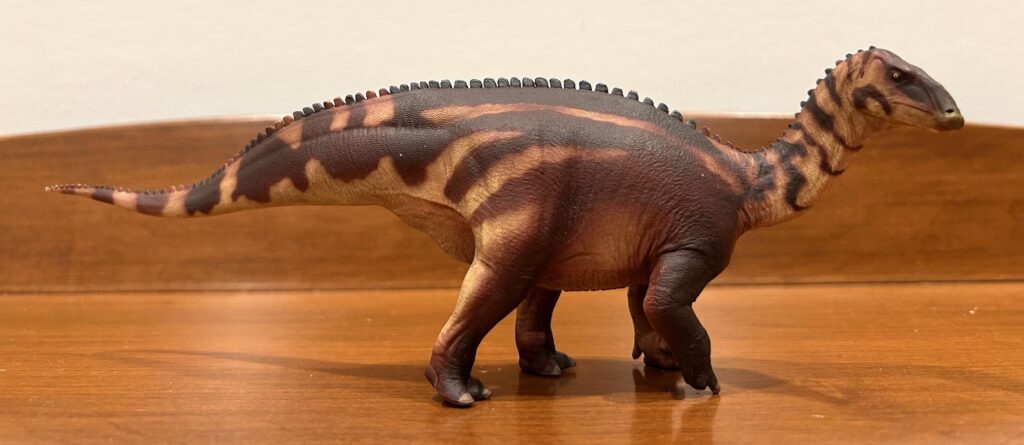
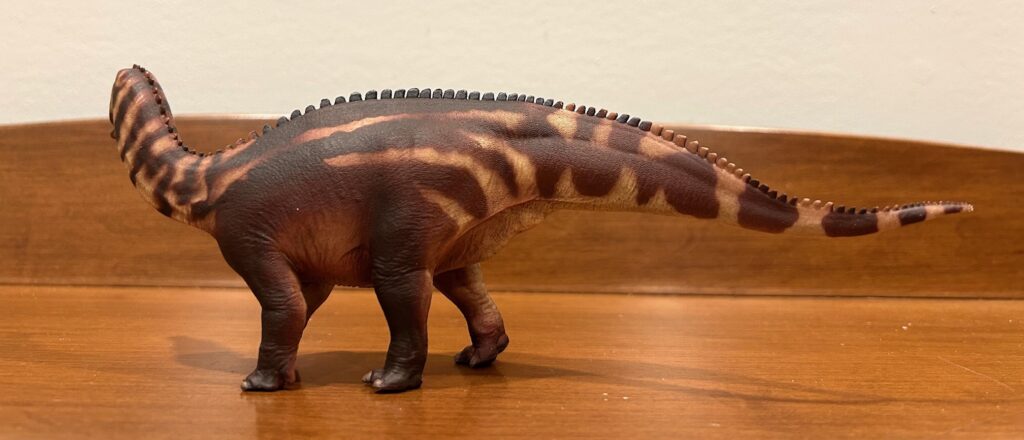
Bakari the Lurdusaurus was released by PNSO in 2025. He is sculpted in a galumphing pose with his head turned to the right, his right forelimb in midstep, and his long tail swinging to the left. He measures 22.5 cm long and 8 cm tall, whereas size estimates for the real animal range between 7 and 9 metres long and 2 metres tall.
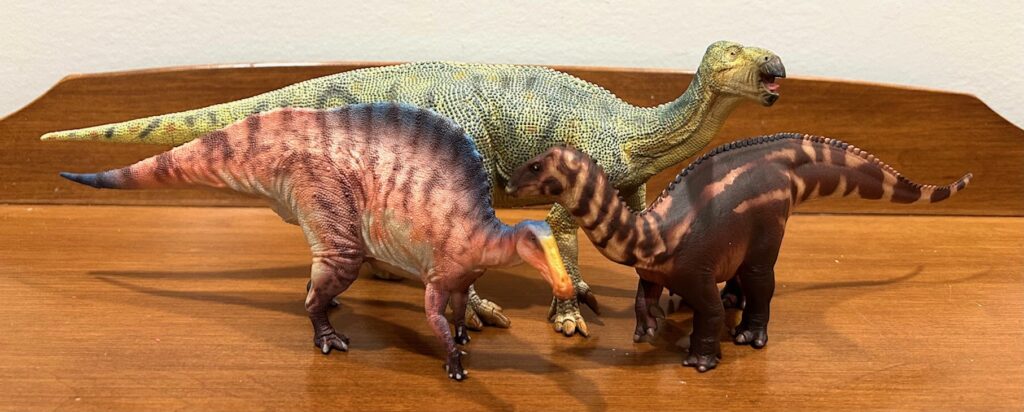


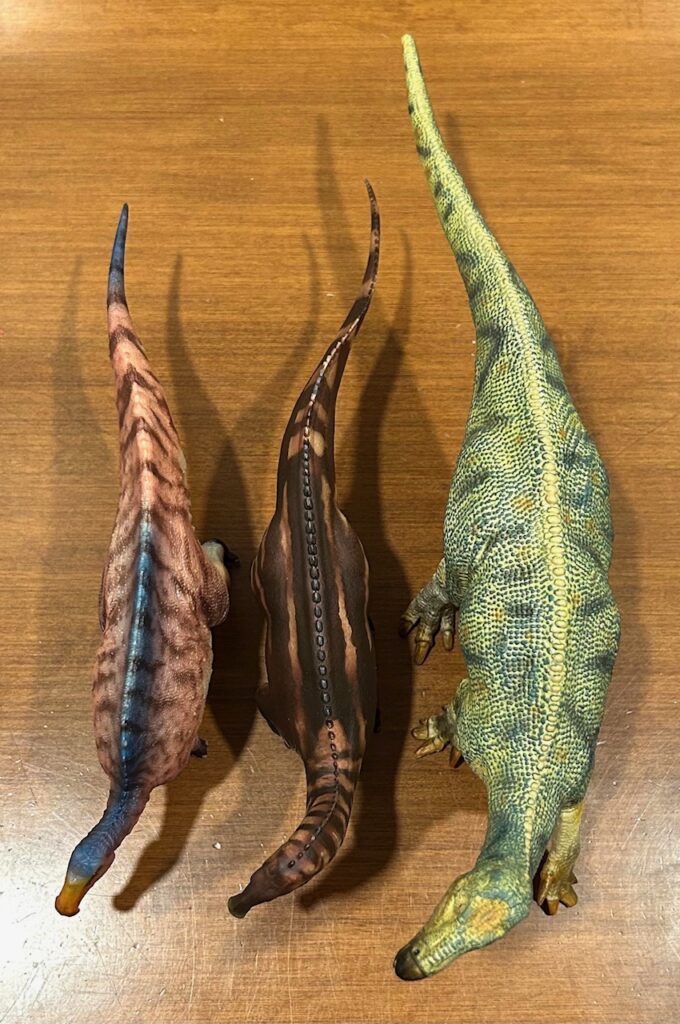
Bakari’s base colour is light brown with lots of dark brown forming patterns on his tail, torso and neck. His claws and thumb spikes are muddy brown and the osteoderms running down the length of his spine alternate between light brown, dark brown, and dark grey. His light and dark brown head features tiny orange eyes and a muddy brown bill. It’s a lot of browns (shocker!), but they go rather nicely together rather.

As you’d expect with a PNSO product, Bakari’s sculpting detail is top notch. Minute pebbled scales all over, with a relative minimum of creases and wrinkles here and there. I especially like how realistic the underside of the neck looks. Rather than all being uniform, the osteoderms start out on the back of the neck as triangular and spaced apart, but then they become larger, blunter, and more tightly pack on the torso. Eventually, they go back to being small and triangular near the tip of the tail. Little touches like that really do help to make a prehistoric toy seem more realistic.

Bakari’s head is pretty typical of an iguanodont, with a long, sloping snout that bulges slightly at the tip. The downturned mouthline, beady eyes, and orbital ridges give him a decidedly serious, even disapproving appearance. You’d best mind your Ps and Qs around this chap. His neck is indeed long, so much so that you wouldn’t mistake him for any other known iguanodont.

The best preserved remains of Lurdusaurus are its hefty, powerful forelimbs, and Bakari certainly boasts these. His hands feature super chunky thumb spikes and blunt claws on the second and third digits. They are indeed a far cry from the long, gracile forelimbs you see on the later hadrosaurs. A far cry from Iguanodon‘s too for that matter. Bakari’s hind limbs are similarly short and stocky. He really doesn’t look capable of walking bipedally.

Bakari’s torso is appropriately big, wide, and deep, but to be honest, I feel like it should have been sculpted to be a bit thicker. He doesn’t quite seem like enough of a heavy lizard, doesn’t give off enough of a hippo vibe for me. But that’s a rather personal quibble and given that Lurdusaurus isn’t yet known from a complete skeleton, it’s not a dealbreaker.

The information booklet included with Bakarai features some pleasant art in the how-to-draw section and a slew of toy images, as usual.

And the poster is yet again an image of the toy. It does admittedly look pretty cool submerged in water like that.

Overall, Bakari the Lurdusaurus is a beautifully made and fairly unique entry into PNSO’s prehistoric pantheon. Certainly worth picking this one up.

 All articles on the Dinosaur Toy Blog are written without the use of 'AI'